
2023 Incubator Experiment
Bryant’s Roost Incubator Experiment
Bell Buckle, TN
Published August 12, 2023
July, 2023, I embarked on an Incubator experiment with jumbo coturnix hatching eggs from my stock. Since my business model is hatching eggs and assisting with hatching, I needed hands on experience with several different models. I also get asked what incubators I would recommend for different price points and needed that information to make informed answers.
Method:
I took one egg from 21 different breeding sets for each incubator. This was to create a consistent supply for each test group.
Due to the number of incubators I had, I needed to break it into 2 phases, 3 weeks apart.
The incubators were set on a plastic shelf unit near the window air unit inside my barn office. The air was set on 74F and was held consistent.
The GQF 1502, the Hatching Time C180 and the tabletop used for hatching are my personal incubators.
The Brinsea, Maticoopx, 3 Nature Right 360’s, Styrofoam incubator, and 2 generic ones were borrowed.
No companies had any influence on the results and nothing was contributed financially to the process.
The process was to set the incubator to factory settings and assess the results. To imitate a novice.
Each incubator was turned on for 24 hours and then loaded with eggs. Eggs were removed at day 21 and opened for analysis. The results were broken into 3 categories, Hatched, Unfertilized and Dead in shell or Quitters. On average 3.9 eggs were considered unfertilized in each group, either they were unfertilized or were early quitters. These were not added into the hatch rates used for the conclusion.
I also attempted/accomplished making contact with each manufacturer with an issue to grade them on customer service.
Each incubator was assessed for ease of cleaning and operation.
I did place a Govee thermometer in each for several days to take sample readings.
The ambient humidity is mid 30’s. Each incubator read in the mid 30’s consistently except the Hatching Time which was set at 40% for 14 days and 60% for 7 days.
Observations:
Nature Right 360.
I was unable to locate a customer service number or email.
The machine was fairly self explanatory
The machine was easy to clean
Removing the lid allowed the chicks to “run away” and fall out.
An “extender” was on one of the machines which prohibited the chicks from falling, worth The extra cost to fix that issue
Maticoopx.
I was unable to locate customer service email or phone number
The machine was easy to operate
The machine was easy to clean
The chicks were contained when lid was removed
Styrofoam Incubator.
No brand name on machine, only words, “Made in USA”
I was unable to locate customer service email or phone number
The machine was easy to operate
The machine was not cleanable
The chicks were easy to contain when removing the lid
The machine did not hold consistent temperature
Generic Made in China.
No brand name, only words on it were “Made in China”
2 of these were used in the experiment.
1 had Styrofoam packaging on it , one did not
The alarms consistently went off regardless of settings
The machine was not cleanable
Brinsea Ovation.
I was able to locate customer service. They replied to my first email with a question.
I answered the question promptly and was never contacted again.
The machine was easy to operate
The machine was easy to clean
The chicks were contained when lid was opened
The machine is large for its capacity, bulky and heavier.
The jumbo eggs did not fit well into the quail rails
GQF 1502
I was able to locate customer service and contacted them by email, their preference.
They did answer the questions promptly and thoroughly.
To perform the work, the machine has to be accessed from behind and screws removed.
The machine is big and heavy and deeper than my arm can reach.
It is easy to clean, what I can reach but to perform a deep clean, it is a space and time
commitment.
I set 2 treys, both on turners, no water added, one hatched in bottom, one hatched in
Old plastic tabletop with splash water to 70%
Hatching Time c180
I was able to locate customer service and I received answers promptly.
The back opens on hinges
The machine is big and requires space to access the back.
I can reach the back from the front
It is easy to clean fully from the front
The machine is easy to operate
I set 2 treys, one with turner plugged in, one not. 40%Days1-14/60%days 14-21
Results:
1. Nature Right 360. 6% hatch rate
2. Nature Right 360 37.5% hatch rate
3. Nature Right 360 47% hatch rate
4. Maticoopx 24% hatch rate
5. Made in China-no Styrofoam 59% hatch rate
6. Made in China- with Styrofoam 0% hatch rate
7. Made in USA-Styrofoam 19% hatch rate
8. Brinsea 80% hatch rate
9. GQF – dry/dry 54% hatch rate
10. GQF – dry/wet 65% hatch rate
11. HT-no turn 63% hatch rate
12. HT-turn 85% hatch rate
Conclusion:
I would not recommend the 360 as I felt it inconsistent, and the chick escape was an issue. I felt like the Maticoopx would be worth more investigation if humidity could be kept consistent, I did not attempt this. The Made in China models, I would not recommend at all. The styrofoam I would not recommend at all. The Brinsea is a nice machine, If you have the space and budget for it and the egg capacity works for you, then I would suggest it. The GQF 1502 is hands down the capacity machine. However, with lower hatch rate now verified, I will be looking to convert to adding humidity. I will not hatch in it because it is so hard to clean, I simply cannot reach it all. The Hatching Time machine is the ultimate winner. It holds temp and humidity almost perfectly. It is easy to clean and maintain.
CT-180 from Hatching Time; the one used in the experiment


2022 Feed Experiment
Bryant’s Roost Feed Experiment Bell Buckle, TN
Published November 5, 2022
July 2022, I embarked on a feed experiment with my jumbo coturnix quail to compare three brands of feeds. Since my business model is shipping hatching eggs, I want to make sure the customers are receiving the best fertility rate and the resulting healthiest chicks that have the foundation to grow to their full potential.
All organisms have a genetic map and the ability to grow to their full potential given appropriate nutrition. Depending on goals, the nutrition will vary. This experiment was to find the feed with best nutrition for fertility and subsequent chick vigor.
Method:
The quail chicks hatched on July 27, 2022 were divided into 3 groups.
They were placed inside Hatching Time brand stacked 9” brooders.
The auto waters were used to supply the chicks with the same water supply.
Shop towels were used on the floor of the brooder for 10 days.
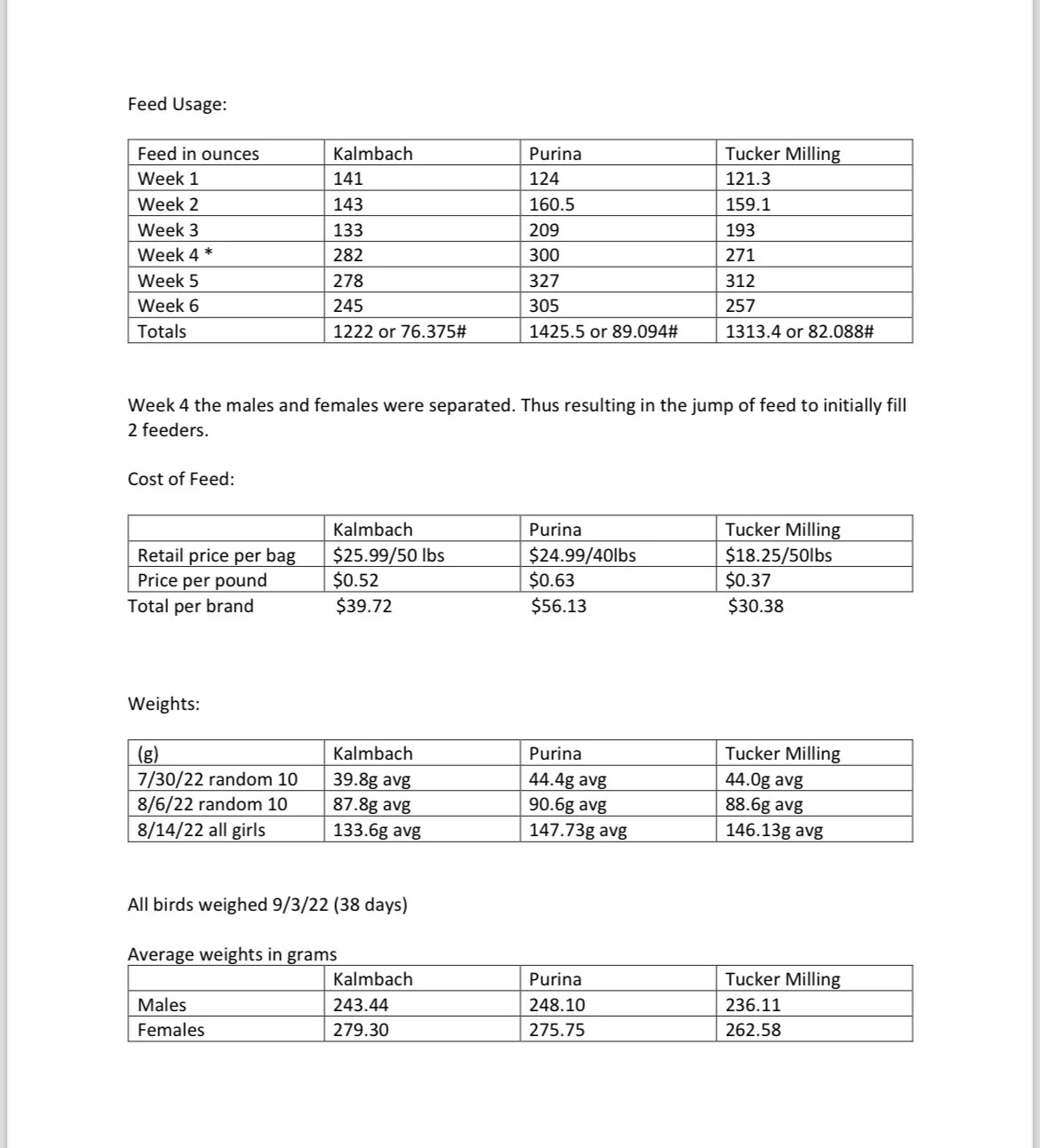
Feed was weighed and placed in the no waste feeders.
Chicks were weighed randomly until 6 weeks when divided into breeder sets and all weighed. The Breeder sets were tagged with colored zip ties and placed in Hatching Time egg roll out cages.
2 weeks were allotted to reach full sexual maturity at which time, eggs from each group were incubated to assess fertility, hatch rate and chick vigor.
The extra roosters, weighed at 8 weeks.
The eggs placed in a GQF 1502 incubator trey and incubated for 14 days.
Day 14, they were moved to a Hatching Time incubator into hatching baskets.
Day 19 each basket was removed, chicks counted, unhatched chicks counted, unfertilized eggs counted.
Day 22 chicks assessed for health.
End experiment.
Feed used:
Group 1- Kalmbach gamebird starter, 28% protein. 50 lb bags Kalmback Show Flock Layer Feed
Group 2- Purina Gamebird Starter 30% protein. 40lb bag Nutrena Layer
Group 3- Tucker Milling Quail starter, 30%. 50lb bags Tucker Milling non-GMO layer mini pellets.
Interest of transparency, Kalmbach donated the starter for the experiment. Nutrena Donated layer for the experiment. Tucker Milling and Purina did not answer emails.
Up to age 6 weeks
Kalmbach had one death
Purina had 2 deaths
Tucker Milling had 2 total die, one due to injury
Egg Laying
Kalmbach 1st egg 8/31/22 Purina 1st egg 8/30/22 Tucker Milling 1st egg 9/2/22
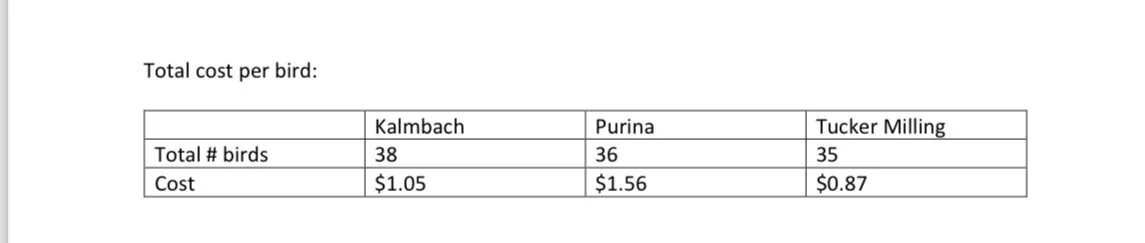
$0.87
At age 6 weeks, The largest males of each group were placed in breeder sets of 1:4 The Kalmbach breeders were then fed the Show Flock Layer, 22%
The Purina birds were moved to Nutrena Layena, 16%
The tucker milling breeders were changed to TM Non-GMO Layer mini pellets, 16%
At age 8 weeks, eggs from each group were incubated in a GQF 1502. No water added. They were in the incubator at the same time, therefore the same conditions, in labeled treys.
On Day 14 , they were moved to hatching baskets in a Hatching Time incubator. Temp at 97.8F and 55% humidty.
Day 19 they were removed from the incubator, no late hatches were allowed.
In the essence of transparency, I had test hatched a few from each group to check fertility before placing treys in the incubator for sake of the experiment. I was aware that fertility was low on the Purina, therefore I placed more of the Purina eggs in the test trey to get a more accurate reading.

Chick vigor was good and at 2 days, all were alive and healthy appearance. They were fed Tucker Milling quail starter.
This concluded the feed experiment.
Observation points:
During the course of the brooding, I made some observations on the physical condition of the birds.
The Kalmbach birds were calm but active. Their feathers were healthy looking. Feet were healthy, zero poop balls on toes. The feces was drier and was less volume. The brooder itself stayed cleaner.
The purina brooder had an extreme amount of buildup. It was in constant need of cleaning. The feces was wet and had a distinct odor. The birds were flighty and agitated. The feet were in very poor condition. Poop balls on majority of toes cutting off circulation. They required much more upkeep than the other 2 brooders. The feathers were dingy and hung poorly. 2 of the birds developed bumble foot.
The Tucker Milling Brooder was not as dry and clean as the Kalmbach, but a close second. Very few poop balls on toes. The brooder required minimal effort to clean. Feathers and feet were healthylooking. Feceswasdry.
Conclusion:
My business model is selling hatching eggs. I believe all things shall be done with integrity and transparency. I must nourish my breeders in order for them to produce a quality product that can withstand shipping stresses and on which to build my reputation.
The fertility rate of the eggs is my main focus, with chick vigor being second. I believe the Tucker Milling company has a good feed recipe at a reasonable cost. Kalmbach had a similar fertility rate and grew the biggest birds at what I believe is a reasonable cost and least amount of cleaning labor.
I understand that Tucker is a regional feed and not available to everyone. Kalmbach is available nationally thru a variety of locations, including shipping. They have a 800 number with helpful people to help you locate a dealer. Purina and Nutrena is easily found at TSC and any Purina feed dealer.